Play-based education is a child-centered approach to early learning in which children learn through self-chosen, self-directed play rather than direct instruction. In a play-based classroom, children explore, experiment, and use their imaginations while educators observe, support, and extend their learning. Research on play shows it supports brain development, mental health, social-emotional skills, physical development, and academic success.
If you’re an early childhood educator, preschool teacher, childcare provider, or parent in Maine wondering what play-based learning looks like in practice, you’re in the right place. Play-based and outdoor learning don’t require expensive materials or a perfect playground. They can start with simple open-ended items like sticks, stones, and pinecones, known as loose parts, and a shift toward letting children lead.
If you’ve ever…
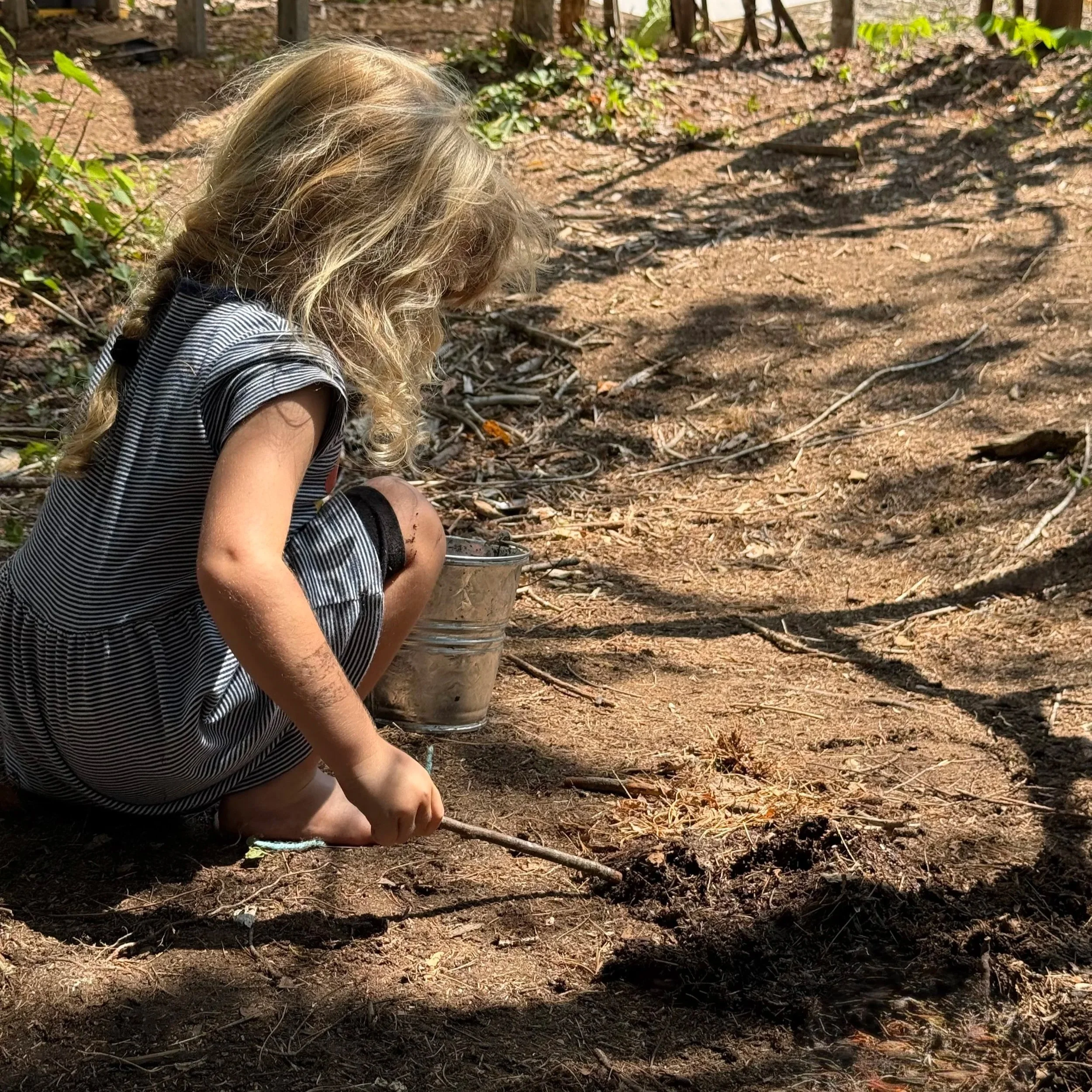
watched a child spend an hour building a “fairy village” out of sticks, moss, and acorn caps
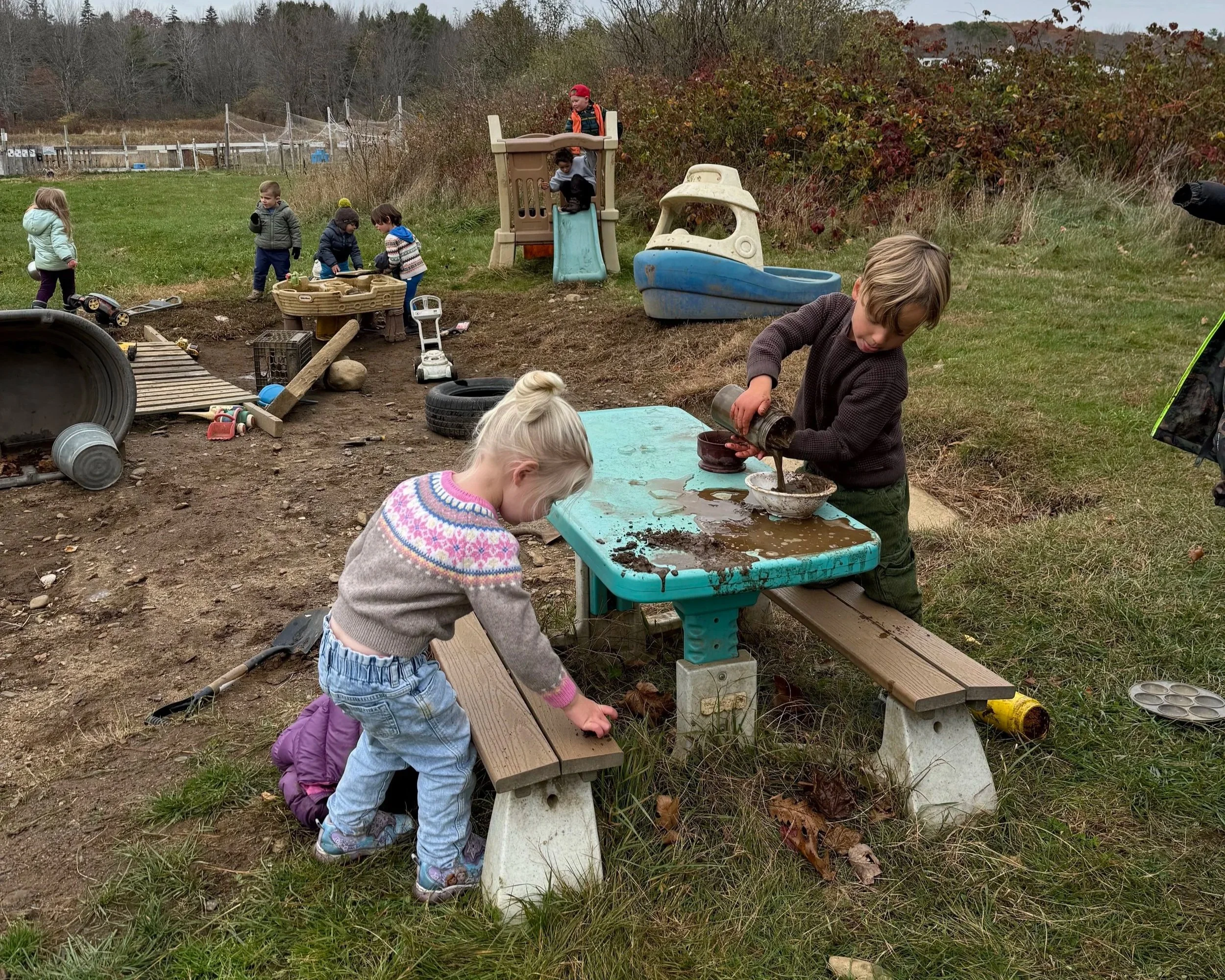
or seen a group of young students prepare an entire meal out of mud
or observed early learners pretending to be animals among the bushes in your outdoor classroom
you’ve seen play-based education in action: deep focus, big ideas, and a lot of learning, with no worksheet in sight. Play isn’t a break from learning. It is learning.
MaineECO is a resource that helps early educators and childcare providers bring outdoor, nature-based (ONB) education and loose parts play into their programs. We answer your questions, offer practical guidance, and provide simple, low-cost tools for starting a loose parts collection, keeping open-ended play safe, and teaching outdoors with confidence.Download our play-based learning check-list to start implementing this pedagogy into your classroom with confidence. We also provide articles, book recommendations, and a Rooted In Play training to support you along the way.
What Counts as Play?
“Play” gets used for lots of things, from board games to organized sports to educational apps. But researchers who study play, like psychologist Peter Gray, describe it more specifically. True play is:
Chosen by the child. Not selected from a menu of options an adult provides.
Guided by the child. Not interrupted or redirected by an adult.
Intrinsically motivated. The purpose is deeply meaningful to the child.
Process-oriented. No outcome is required. A child may set a goal, like building a dam, and it may or may not come to fruition. The doing is what matters.
Gray adds that play has structure and rules that come from the minds of the players, not from physical necessity. It’s imaginative and mentally removed in some way from “real” or “serious” life. It also involves an active, alert, but non-stressed frame of mind. In other words, children in play are engaged and thinking hard, without the pressure of performing.
You must also ask yourself; “what is my relationship to the children I’m encouraging to partake in play?
The trusting, attached relationship between child and adult is key to a child’s ability to play.
Children’s emotional and physical needs are met with attached trusted adult
Children play freely and comfortably when in the present of a trusted adult
Adults must be in strong relationship with children in order to observe play and assess risk
Play in the classroom has been on a 40-year decline
Many of us remember childhoods filled with unstructured time outdoors. Over the last four decades, that has steadily eroded, and for several reasons:
The Fear Factor (late 1980s): Growing worries about safety led to more supervised, indoor, and scheduled time.
Academic Standards and Rigor (2000s): Pressure for early academic achievement pushed play out of classrooms.
The Tech Era (2008): Screens began competing with outdoor and imaginative play.
The Economy of Pressure (post-2010): Busy schedules, enrichment activities, and constant performance expectations left little room for free play.
A decline this long and this layered calls for a systemic solution. The good news is that everyone has a part to play, whether you’re a teacher, a parent, a childcare provider, or a community member.
Stuart Brown, in Play: How It Shapes the Brain, Opens the Imagination, and Invigorates the Soul (2010), makes the case that play is not a luxury. It’s a fundamental human drive. The benefits show up across nearly every area of a child’s life:
It’s an instinct and it builds the brain. Children are wired to play, and play is how developing brains make sense of the world.
It supports mental health and wellness. This is especially true of outdoor play, which gives children room to move, explore, and regulate their emotions.
It builds the whole child. Play supports physical development, social-emotional skills, and positive behavior. Children practice negotiating, sharing, problem-solving, and recovering from disappointment.
It leads to greater academic success. Children who have rich opportunities to play develop the focus, creativity, and flexible thinking that support learning in every subject.
It builds connection with nature and stewardship. Children who spend time playing outdoors form relationships with the natural world, and children who love the outdoors grow up to protect it. In a state like Maine, with its forests, shorelines, and fields, that connection is right outside the door.
Time and play - c
hildren need long periods of play for brain development and learning.
15-Minutes: Children begin exploring their options; if they’re at a play deficit, you’ll notice a burst of energy.
30-Minutes: Children become engaged and intrinsic motivation is activated.
45-Minutes: A child’s play deepens and brain connections begin to form.
60-Minutes: With increased time, play becomes more imaginative, immersive and self led.
Play and the Brain.
It is easier and less costly to form strong brain circuits during the early years than to ‘fix’ them later. In non-play based early education schools, a child often spends pre-K through 3rd grade being told to sit still, lineup, listen, and are often being over-instructed, meaning we are frequently giving them the questions and the answers.
In high school, college and beyond we ask our students to be creative, innovative, solve problems & work together but we didn’t create the foundational brain for that work when they were young. We are then trying to ‘fix’ the brain we created.
“The development of a child’s brain architecture provides the foundation for all future learning, behavior and health” - Center for Developing Child at Harvard University
Sensorimotor Stage, (ages 0-3 years)
Rapid growth in # of synapsis
Brain is 90% of adult size by the end of this period
Development takes place through sensory experiences
Egocentric (one perspective)
Pre-Operational Stage, (ages 3-7 years)
Pruning process begins and takes place over these years
Connections that are either strengthened or pruned dictate how the brain can function later
Highly creative, imaginative and non-logical
Still Egocentric (one perspective)
Concrete Operational Stage
Brain integration increases, connections take place across hemispheres and brain areas
Logical thought develops
Less egocentric (multiple perspectives)
Bringing Play Back, One Loose Part at a Time
Play-based education doesn’t require a big budget or a perfectly designed playground. One of the simplest ways to invite child-directed play is through loose parts: open-ended materials like sticks, stones, shells, fabric scraps, pinecones, and cardboard tubes that children can move, combine, and transform however they imagine.
Loose parts have no instructions. A stump can be a table, a stage, or a mountain. And that is exactly what makes them so powerful: the child chooses, the child directs, and the child creates.
Join Us
At MaineECO, we believe nature should never feel off-limits, and that great learning doesn’t require expensive materials. As a Maine resource for outdoor and play-based education, we help early educators, families, and childcare providers bring loose parts play into their programs with confidence. Whether you’re a new outdoor and nature-based (ONB) educator wondering what loose parts are, how to start a loose parts collection, or how to keep open-ended play safe, MaineECO offers educational expertise, educator support, and resources that make implementing outdoor curriculum into your classroom simple.