
We advocate at the school, state, and national levels to shape policies that support outdoor learning, equitable access to natural spaces, and the integration of nature-based approaches in early childhood systems.

Public Policy and Advocacy Group
2026-2027 Call Schedule (monthly on the 4th Tuesday of each month at 1:00pm)
Oct 27, 2026 01:00pm
Nov 24, 2026 01:00pm
Dec 22, 2026 01:00pm
Jan 26, 2027 01:00pm
Focus areas:
How Maine’s QRIS Rising Stars for ME could better support outdoor nature based learning for young children.
MaineECO has joined the Maine Green Schools Network Guiding Board to advocate for accessible and appropriate early childhood climate education and school environments that support that.
Facilitated by Lisa Henderson, co-founder of Sprouts Farm and Forest in Kindergarten, Millis, MA, a MaineECO Steering Committee member; as well as an outdoor, Nature-Based Play educator, advocate and mentor.
Outdoor Childcare Licensing Group
This is your opportunity to get involved while regulations for outdoor early education are being drafted.
Meetings are the first Monday of the month from 10:30-11:30am
Participation is open for drop-ins and the meeting link is ongoing. Join us when you can.
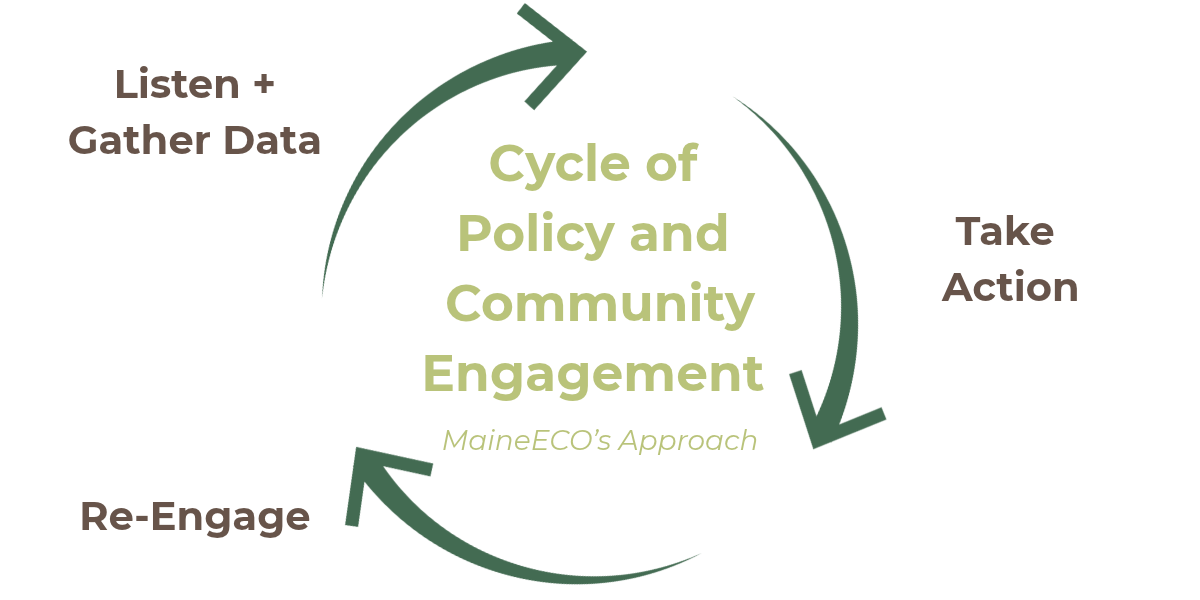
Strong systems change is not linear.
It is a continuous cycle of listening and gathering data, taking action, and re-engaging our constituents with new findings and outcomes.
Throughout this pattern, we’re consistently reminded that the relationships we build along the way to policy change are the most important part.
-
MaineECO creates opportunities for early educators to learn, and share their expertise through:
Monthly public policy & advocacy calls
MaineECO professional development and partner programs
Highlighting regional Community of Practice groups
Sharing surveys, the CBEL+ Census, and more
-
Time is often the biggest barrier keeping early childhood educators from advocating for what they need, let us do the heavy lifting for you. We listen closely and represent your needs but use our paid staff to:
Research important topics to you
Build long term relationships with state agency workers and policy makers
Attend important convening and events of funders, state agencies, and cross sector organizations on your behalf
Investigate the best path forward for lasting systemic change
-
Through action in phase 2, MaineECO shares what we learn and can see clear pathways emerging where we can have the greatest impact. At this point we e-engage practitioners for decision making and engagement on creating the impact we all wish to see. This might look like:
Reports or webinars offered to the field on various policy initiatives
Convening specific working groups or advisory boards on certain topics
Collaboratively creating strategic steps to move forward
-
As the landscape shifts, so do our needs. We recognize that with each year make progress on our mission, new or different barriers may emerge or some initiatives need more time and attention to go deeper. And so we listen closely and start the cycle over again. The PPA group works on:
Outdoor Child Care Licensing
MaineECO is working alongside state agencies and early childhood professionals to develop licensing regulations that recognize and support outdoor and nature-based child care programs, removing barriers while ensuring safe, high-quality experiences for children.
Climate Education and Maine’s Green Schools Network
MaineECO is advocating for early childhood to have a strong voice in Maine’s climate education initiatives and Green Schools Network, ensuring that outdoor learning, environmental stewardship, and nature connection begin in our youngest years.
Access to Land & Gear for All
MaineECO is working to remove barriers to outdoor learning by increasing access to appropriate outdoor clothing, gear, and natural spaces, ensuring that all children and educators have opportunities to learn and play outdoors every day.
Indigenous Perspectives in Early Childhood Education
MaineECO is exploring opportunities to learn from and elevate Wabanaki perspectives, knowledge, and relationships with the land, fostering respectful partnerships that help early childhood educators honor Indigenous wisdom and ways of knowing.

Current Work
Outdoor Childcare Licensing

MaineECO works to support and expand licensing pathways for outdoor and nature-based (ONB) early childhood programs across the state. In partnership with the Office of Child and Family Services (OCFS) licensing team, we help ensure licensing practices reflect the unique needs of outdoor programs while maintaining quality and safety. This work is vital to creating more accessible, sustainable, and equitable opportunities for young children to learn and grow in the outdoors.
This work includes:
Conducting surveys and data collection to understand provider needs and barriers
Supporting training for OCFS licensors on outdoor program models
Hosting an annual outdoor licensing webinar to inform and engage providers
Convening the Outdoor Licensing Advisory Group, a group working to write ONB rules and regulations in Maine
Why it matters:
Creates more accessible and equitable opportunities to ONB programs
Supports and protects ONB childcare providers
Raises awareness in the general public on benefits of outdoor time for children
Brings resources to ONB programs in Maine
Climate Education
Two biggest factors contributing to environmental stewardship in adulthood:
Time spent in nature as a child.
Adult role models that care for nature.

MaineECO’s Climate Education Initiative recognizes that addressing the climate crisis begins in early childhood. By supporting educators, caregivers, and communities, we aim to build a foundation for lifelong climate awareness, resilience, and stewardship—starting with our youngest learners. This work is rooted in equity, sustainability, and the belief that early experiences in nature help children grow into adults who care for the planet.
What is early childhood climate education?
It’s not about teaching facts or fear about climate change. It’s not about studying something indoors. It’s not catastrophizing. Instead, it centers on
Nurturing a relationship with nature
Being supported by adults who themselves are connected to the natural world
Regular time outdoors in all seasons and weather
Develop small, place-based connections
Observing and being curious about natural phenomena
This kind of learning fosters the emotional and sensory connections that serve as a powerful foundation for environmental responsibility later in life.
We can not protect something we do not love.
We can not love what we do not know.
We cannot know what we do not see. Hear. Sense. -Richard Louv